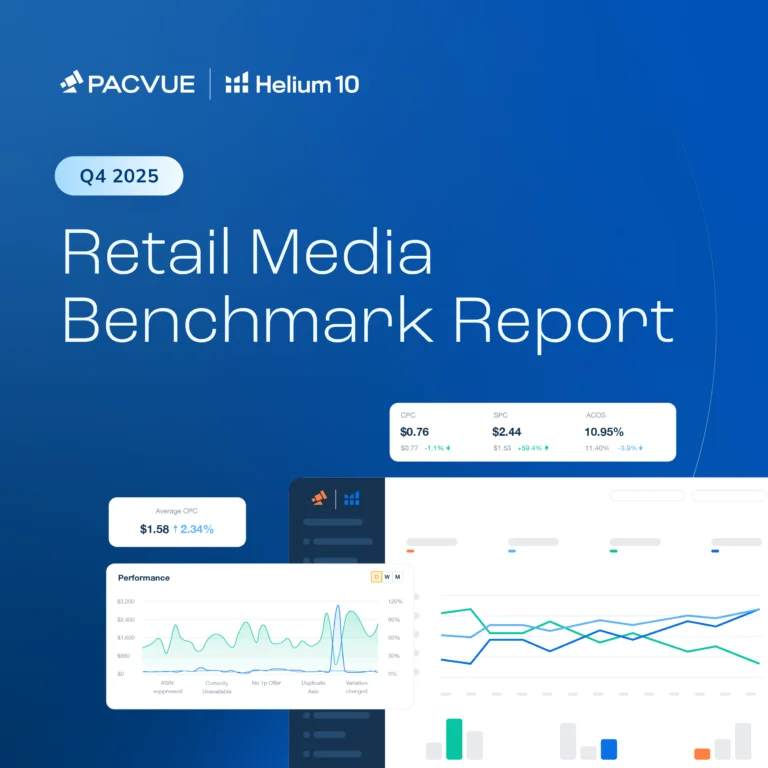
Q4 2025 Retail Media Benchmark Report
Discover how brands invested, performed, and adapted across U.S. retailers in the final months of 2025.
Explore trends from the most competitive shopping season of the year, with full-quarter advertising benchmarks across Amazon, Walmart, Instacart, and Target as well as spotlights on the biggest takeaways from seasonal tentpoles.
Pacvue’s Q4 2025 U.S. Retail Media Benchmark Report delivers a deep dive into performance trends, revealing where advertisers invested, which tactics delivered the strongest returns, and how budgets shifted across categories. The report highlights how media costs, ROAS, and conversion rates changed quarter over quarter, offering data-driven context for brands planning 2026 campaigns.
You’ll gain access to comprehensive benchmarks powered by Pacvue, drawn from thousands of advertisers and billions in ad spend. Use these insights to compare your results to industry leaders in the U.S. market, refine your retail media strategy, and stay ahead of the competition as retail media continues to evolve.

Q4 2025 Amazon Ads Trends
Sponsored Brands made meaningful efficiency gains in Q4, narrowing the ROAS gap with Sponsored Products through higher conversion. These gains were driven by improved conversion rates and faster ROAS growth than Sponsored Products. While Sponsored Products continued to deliver slightly higher absolute ROAS, Sponsored Brands narrowed the performance gap over the course of the quarter. Importantly, these gains were not driven by larger basket sizes, but by improved conversion efficiency as shopper intent fluctuated across Q4.
Q4 2025 Walmart Connect Trends
Walmart ads delivered more efficient traffic in Q4, with higher engagement and stable-to-lower costs. In Q4, both Sponsored Brands and Sponsored Products on Walmart drove significantly higher engagement without an increase in cost per click, signaling improved ad relevance and a more efficient traffic environment. Sponsored Brands stood out, combining a sharp lift in CTR with materially lower CPC year over year. In a quarter that typically brings rising competition, this dynamic suggests Walmart (and Sponsored Brands specifically) allowed advertisers to capture more shopper attention without paying more for it.
Q4 2025 Instacart Trends
Instacart Display delivered outsized efficiency gains in Q4, while Sponsored Products showed steady performance improvement. Instacart Display saw a sharp improvement in efficiency and returns in Q4, with materially lower ACOS and significantly higher ROAS both quarter-over-quarter and year-over-year. Sponsored Products also improved profitability, but at a more incremental pace, reinforcing its role as a steady performance format rather than a breakout efficiency driver. Together, these trends suggest that while Sponsored Products provided consistent returns, Display emerged as a stronger lever for efficiency gains on Instacart in 2025.
Q4 2025 Instacart Trends
Target delivered stronger engagement and efficiency in Q4 while continuing to scale advertiser investment. In Q4 2025, Target advertising performance improved across key engagement and efficiency metrics, even as advertiser investment increased. CTR rose quarter over quarter, while CPC declined, easing cost pressure and signaling stronger ad engagement. At the same time, efficiency improved meaningfully, with lower ACOS and higher ROAS, indicating better returns on spend as brands scaled budgets into the quarter. Together, these trends point to a healthier balance between growth and performance in Q4 than in the prior quarter.
Q4 2025 Category Trends
Categories with repeat or needs-based demand were structurally better positioned to convert Q4 traffic. In Q4 2025, categories tied to habitual or essential purchasing consistently delivered the highest conversion rates across Amazon. Grocery, Health & Household, Pet Supplies, Baby, and Beauty & Personal Care all converted materially better than discretionary categories such as Electronics and Home & Kitchen. This conversion advantage helped support steadier performance during the most competitive quarter of the year, even when returns were not the highest overall.