Amazon Marketing Cloud (AMC) has long been a powerful lens into advertising performance, and it just got more accessible. As of June 2, 2026, Amazon is making two of its most valuable datasets, Amazon Retail Purchases (ARP) and Flexible Shopping Insights (FSI), available to all AMC users at no additional cost.
AMC audiences built from these datasets have been available in Pacvue for a while, and users already have access to the most popular audience templates. But the real opportunity is the analysis layer, and it has largely gone untapped for most brands. The ability to dig into purchase behavior, measure lifetime customer value, and build sharper acquisition strategies is now open to every brand running AMC, just in time for Amazon’s largest peak shopping event.
In this post, we’ll cover what each dataset is, what it actually tells you, and how to start using ARP data and FSI data to improve your reporting, targeting, and advertising performance inside Pacvue.
What Is Amazon Retail Purchases (ARP) and Why Does It Matter?
Amazon Retail Purchases (ARP) is a dataset inside Amazon Marketing Cloud that gives advertisers access to full transaction-level purchase history, regardless of whether an advertising touchpoint was involved. It covers up to five years of purchase data, making it uniquely suited for NTB analysis, customer lifetime value tracking, and acquisition strategy.
Standard AMC only shows you what happens after an ad exposure. If a customer sees your DSP creative or clicks on your Sponsored Product ad and then converts, you’ll see it. If the same customer converts without viewing or clicking an ad, you won’t; the transaction is effectively invisible.
ARP closes this gap. Accessed via the ‘Amazon Retail Purchases’ table in AMC, it draws from the same transaction-level data that powers Vendor Central and Seller Central reporting. Inside AMC, you can track each user’s purchase journey rather than treating every purchase as a single isolated event.
The standout capability is the lookback window: up to 5 years of purchase history. No other AMC data source comes close. That makes it uniquely suited for:
- Establishing flexible NTB baselines. Standard AMC NTB reporting is limited to a fixed lookback and only covers ad-exposed customers. Retail Purchases lets you define your own lookback window, calibrated to your brand’s actual customer lifecycle.
- Tracking customer lifetime value. See how customers acquired during a specific period accrue value over months and years, and identify which products or seasons generate the highest long-term revenue per user.
- Building acquisition strategy with retail-level Amazon sales data. Use holistic gateway rates by ASIN to select the best products for attracting new customers in your ad creative.
Get Started with Pacvue: Entry ASIN Performance
A practical first step is the Entry ASIN Performance report in Pacvue, which uses Retail Purchases data to show you which ASINs are most effective at bringing new customers into your brand, across all purchasers, not just ad-exposed ones.
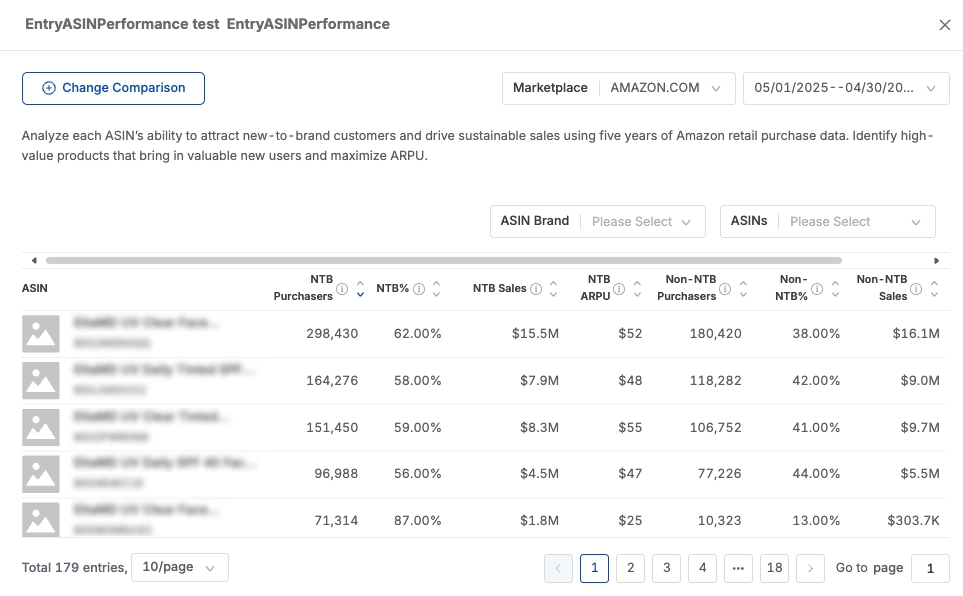
This report breaks down NTB purchaser volume, NTB%, and NTB sales by entry ASIN, so you can immediately see which products are driving acquisition and at what value. Use it to:
- Prioritize acquisition-focused ad spend behind your highest-converting gateway products
- Set internal NTB benchmarks to evaluate whether your campaigns are moving the needle
- Identify underperforming ASINs where acquisition rate lags the portfolio average
Want to go deeper? A natural next question is: once a customer enters your brand through a particular ASIN, what do they buy next? Mapping that second-purchase behavior unlocks cross-sell targeting and replenishment strategies that most advertisers haven’t built yet. Pacvue Agent can help you write the custom AMC query you need to get there.
What Is Flexible Shopping Insights (FSI) and Why Does It Matter?
Flexible Shopping Insights (FSI) is an AMC dataset that surfaces shopper behavior, including detail page views, add-to-cart events, and purchases, for both ad-attributed and organic customers. It covers a 12-month window and enables campaign-level LTV measurement beyond standard short-window attribution.
While Retail Purchases gives you the full transaction record, Flexible Shopping Insights gives you visibility into how performance varies between organic and ad-attributed purchasers.
Standard AMC is inherently ad-centric; every insight it generates is anchored to an impression or a click. FSI breaks that constraint by surfacing organic shopper behavior: detail page views, add-to-cart events, and purchases that happened without a single advertising touchpoint.
It also covers a 12-month window of data, making it a better tool for actionable, campaign-tied LTV analysis than ARP, which is more suited to longer-term brand benchmarking.
With FSI, you receive two key benefits:
- Separating organic from paid performance. FSI lets you isolate ad-attributed purchasers from non-ad-attributed purchasers and compare behavior side by side, giving you an honest picture of how much of your sales volume advertising actually drives versus organic demand.
- One important caveat: AMC’s definition of “ad-attributed” is based on impression data within the AMC reporting window and may not perfectly align with how your campaign reporting defines exposure. Treat the organic/paid split as directional rather than definitive.
- Campaign-level LTV, not just last-click returns. Rather than evaluating spend efficiency based on a 14-day attribution window, FSI lets you see how customers acquired by a specific campaign performed across a full year: what they spent, how often they returned, and what it cost to retain them.
Get Started with Pacvue: CLTV Cohort Report
The CLTV Cohort report in Pacvue brings FSI data into a visual cohort heatmap that shows how customer value compounds month over month after acquisition.
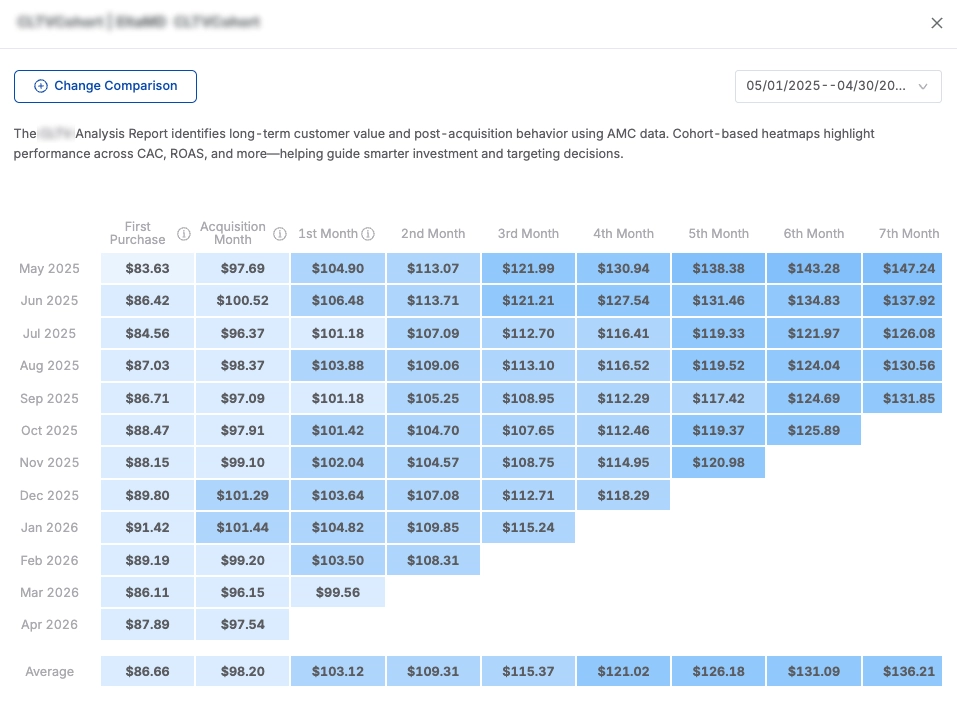
Each row represents a cohort of customers by their first-purchase month. Each column shows cumulative spend through subsequent months. The result is a clear view of which campaigns and time periods are generating customers who stick around and keep buying. Use it to:
- Shift budget allocation toward campaigns with demonstrated long-term ROAS, not just short-window efficiency
- Identify seasonal cohorts where retention drops off and focus DSP efforts on re-engagement. Prime Day cohorts in particular are worth tracking closely, customers acquired during high-velocity sales events often show distinct retention patterns that inform how aggressively you invest the following year.
- Build a business case for upper-funnel investment by quantifying how those customers perform 6–12 months out
Ready to learn more? One of the most valuable questions FSI can answer is whether customers acquired through an ad have a meaningfully different LTV than customers who found you organically. If they do, that changes how you think about customer acquisition costs and what you’re willing to spend. Pacvue Agent can help you write the query to run that comparison.
Start Experimenting Now
The removal of subscription costs for Amazon Retail Purchases and Flexible Shopping Insights creates a real opportunity to do more with data you may already be sitting on.
With Prime Day on the horizon, the timing couldn’t be better. Brands that use ARP to identify their top entry ASINs and FSI to understand which customer cohorts retain best will be able to make smarter budget decisions before the event, not just react to results after; Our Prime Day 2026 Prep Guide walks through how to get your campaigns, budgets, and measurement framework ready, and our Summer Sales Hub has everything you need in one place.
If you want to know how to get started in Pacvue, or want help thinking through the right use cases for your business, we’d love to explore how we can work together.