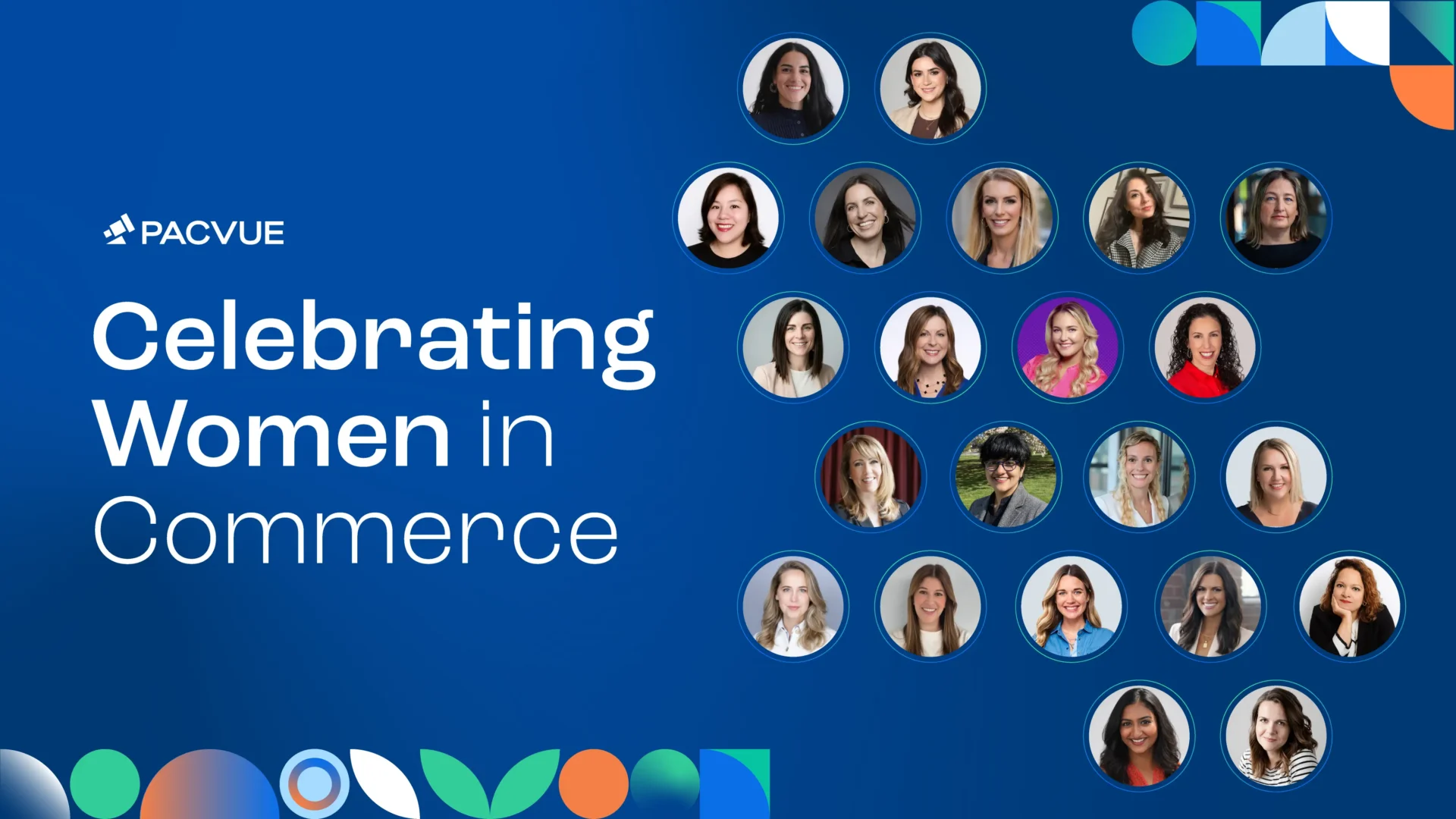
No one feels ready when they step into the roles that change their careers. But the best leaders move anyway.
That mindset defines what it means to be a woman in leadership today, especially in commerce media. Retail media is expanding across networks, data is multiplying, and AI is changing how decisions get made. While the landscape grows more complex, most teams are still trying to catch up.
That’s what makes leadership in commerce media so different right now. It requires navigating constant change while making confident decisions without perfect information.
To close out Women’s History Month, we asked women across commerce media a set of questions about risk, leadership, AI, and what’s changing in the industry.
Their answers were practical, honest, and, in many cases, strikingly similar.
What is your superpower and how has it helped you be successful?
Across every conversation, one theme came up consistently: great leadership starts with self-awareness.
We asked each leader to define their superpower and how it has shaped the way they lead and drive impact.
“I grew up in a rural area and I learned the value of leaning in together and persistence. Community can lift you up and help you develop the grit you need to take on any challenge.” – Paula Despins, Vice President of Measurement, Planning and Amazon Marketing Cloud at Amazon Ads
“My superpower is bringing people together and aligning teams around a shared vision. Creating that alignment not only strengthens how we operate internally but also helps us build stronger partnerships with our clients and partners.” – Sherry Smith, President, Retail Media, Criteo
“My curiosity, resilience and ability to learn, no matter the situation or the subject.” – Nabanita Choudhury, VP E-commerce, Beiersdorf USA
“I deliberately create quiet before I create direction.” – Kavita Cariapa, Head of Commerce, EMEA at dentsu
“Candor, I’m a very direct person” – Sarah Hofstetter, Board Member at Campbell’s and Kenvue
“My superpower is adaptability and resilience.” – Larisa Dumitru, SVP Commerce EMEA at WPP
“Empathetic rapport.” – Catherine Marshall, VP of Sales, Puma
“Translating complexity into executive language.” – Tiffany Moen, Vice President of Digital Services at Parallel Retail Group
“Connecting people is my superpower.” – Lauren Livak Gilbert, Executive Director, Digital Shelf Institute
“Operationalizing anything! Give me a mess, and I’ll be able to unwind it and put a functional team/mechanism/SOP together.” – Lauren Gordon, Vice President, Amazon at The Estée Lauder Companies Inc.
“Combining two different strengths, [vision and empathy], has become my superpower.” – Kara Rousseau, Senior Level Marketer
Was there a pivotal decision, a “yes!” or calculated risk, that changed the trajectory of your career?
In a fast-moving industry like commerce media, career progression is often shaped by moments of ambiguity rather than clear next steps. The leaders who move forward are the ones willing to step into roles before they feel fully ready.
We asked these leaders to share the pivotal decision or calculated risk that ultimately changed the direction of their careers.
Zsuzsanna Leber-Kiss, Former Chief Commercial Officer, Instant Pot Brands : “After spending 20 years in different marketing roles, I was offered the opportunity to also lead Sales. It was a big decision. Moving beyond marketing felt risky, and I knew it would stretch me in new ways. But I quickly saw the opportunity. Marketing and Sales are strongest when they work closely together. Bringing the two teams under one leadership could accelerate growth, create better alignment, and reduce redundancy. Instead of operating in silos, we could move as one team with shared goals.”
Naomi Boonin, UK Lead at WPP Commerce : “After spending a decade client side, I made the decision to move agency side. It was a calculated risk, but also something I’d always wanted to do. I felt it was important to experience both sides of the client–agency relationship and bring my client perspective into the agency world. The transition was challenging at times, but it’s turned out to be one of the best decisions I’ve made in my career and one I don’t regret for a moment.”
Lauren Gordon, Vice President, Amazon at The Estée Lauder Companies Inc.: “Moving from a specialist role to a general manager-type role created an opportunity for me to rapidly scale my knowledge outside of marketing and advertising – I was forced to learn the mechanics of a P&L, deep-dive the production and packaging process for physical goods, understand and reduce transportation time and costs, learn to predict demand, and so much more. I find myself drawing on the knowledge I gained during this transition every day!”
Jordyn Kimel, Senior eCommerce Marketing Manager at Spin Master: “After business school, I started my career in brand management and expected to stay on that path. When the pandemic hit, I was at a food CPG company in Canada as grocery rapidly shifted online. I was asked to join a newly formed eCommerce team to lead retail media and eCom marketing. This was an ambiguous, high-risk move and very different from my planned next step. Saying “yes” changed my trajectory. For the past six years, I’ve led and scaled eCommerce and retail media as key growth drivers.”
Tiffany Moen, Vice President of Digital Services at Parallel Retail Group: “Nearly a decade into my merchandising career, I made the decision to leave a defined role and help build a new digital division at a small retail agency. It meant stepping away from a clear path to build something that did not yet exist and becoming accountable for the outcome without certainty that I had all the answers. What drew me was the opportunity to apply my retail background while helping build new digital capabilities for brands navigating online marketplaces. That experience reinforced something I still believe today: the biggest advantage in commerce is building capability before the market demands it.”
If you could give your younger self one line of advice, what would it be?
The advice leaders carry with them often comes from experience, not theory. It reflects the lessons learned through risk, growth, and moments of uncertainty.
We asked each leader to share the one line of advice they would give their younger self.
“Stand firm in your principles and trust your sense of what’s right.” – Laura Meyer, CEO of Envision Horizons
“Work hard, but also network and be vocal about your achievements and don’t be shy to ask for what you believe you deserve.” – Nabanita Choudhury, VP E-commerce, Beiersdorf USA
“Don’t wait until you feel ready. The opportunities that grow you the most are usually the ones that feel slightly too big for you at first.” – Gabi Viljoen, VP & Head of eCommerce, Nestlé Health Science
“Be brave before you feel ready. Be clear, be useful, raise your hand and let the work catch up to your courage. And always, always bet on yourself because if you don’t believe in you, who will?” – Cristina Marinucci & Jacqui Dynowski, Co-Founders and Co-Hosts of SHeCOMMERCE Podcast
“If you’re doing it all, you’re not leveraging your time and value. Ask for help, outsource tasks that drain you, and tell yourself this is not defeat – it is essential to be in a high performing role.” – Brooke Doepke, COO of Voyageur Group
“You can do hard things.” – Kaylee England, Director of Sales at Ashley Furniture
“Find your voice and your inner circle early — your ambition deserves momentum, not hesitation.” – Kavita Cariapa, Head of Commerce, EMEA at dentsu
“Do what you love and be brave enough to take risks.” – Naomi Boonin, UK Lead, WPP Commerce
“Say yes to 90% of things — the most interesting opportunities rarely come with a perfectly clear job description.” – Yara El Saadani, Senior Commerce Strategy Director, UK & Europe
“Be confident, speak up, and participate.” – Catherine Marshall, VP of Sales, Puma
“School teaches you not to plagiarize – that copying is failure; but work teaches evolution – to build on what already exists to move faster and smarter.” – Amy Wu, Director of Commerce, Spark Foundry
“Follow what genuinely excites you and your career will follow.” – Jordyn Kimel, Senior eCommerce Marketing Manager at Spin Master
Who or what is shaping how you think right now?
The way leaders think is constantly evolving, shaped by new ideas, emerging technologies, and the voices they choose to learn from.
We asked these leaders what is currently influencing how they think about their work and the future of commerce.
“I cannot get enough of Adam Grant’s Work Life podcast, [and] Elizabeth Gilbert’s Big Magic was a pivotal recent read.” – Brooke Doepke
“The Diary of a CEO with Steven Bartlett. Also, on a daily, I’m listening to Kiri Master’s Retail Media Breakfast Club to keep up to speed on Retail Media.” – Catherine Marshall
“Right now, Retailgentic is shaping how I think about the future of commerce and performance marketing.” – Amy Wu
“First, our dear friends Peter and Sri from The CPG Guys. We’re also energized by Women in Commerce Media, and the Unfazed Collective. Finally, Leaders like Melissa Burdick, Christine Foster, Clare Galvao, and Diana Haussling are proof that “you can be unapologetically human and undeniably high-performing.” You don’t have to choose.” – Cristina Marinucci & Jacqui Dynowski
“I am loving the podcast Choice Hacking hosted by behavioral science expert Jennifer Clinehens.” – Yara El Saadani
“Customers. Customers have more means than ever to tell us what they want” – Lauren Gordon
The pace of change in our industry is relentless. What is one change you have made to your playbook since the beginning of the year?
The pace of change in commerce is not slowing down. Leaders are being forced to rethink how they operate, not just what they prioritize.
We asked these leaders what they have changed in their playbook this year to keep up with the demands of a rapidly evolving industry.
Nabanita Choudhury: “I have wholeheartedly embraced AI to become my one true assistant and a fast developing sparring partner.”
Kaylee England: “When change is happening, making sure everyone understands the why helps bring everyone along with you. It is also important to be in it with the team. We recently [made] a strategy shift and after explaining the why my next thing is always what do you need from me to accomplish this.”
Kavita Cariapa: “In commerce, change is constant, so change management needs to be operational and not slideware. It starts with anchoring transformation to a real commercial tension, not trends, then putting structure around it: clear ownership, defined process, and measurable outcomes. As leaders, bringing teams along means being relentlessly clear on the “why”, making process visible, and creating an environment where our people feel both supported in change management and empowered to evolve.”
Yara El Saadani: “I’ve become much more focused on building flexible frameworks rather than rigid strategies. Instead of trying to plan everything upfront, we’re focusing on strategies that allow teams to test, learn, and adapt quickly while keeping a clear long-term direction. Nudging into non-typical commerce conversations, especially non-endemic ones, is my big change for this year.”
Laura Meyer: “An emphasis on AI as service solutions, but also how to operate internally as an organization and really trying to understand what the new responsibilities will be for roles within my company.”
How has AI changed the way you operate as a leader?
AI is not just a productivity tool. It is changing how leaders approach decision-making, problem-solving, and execution in real time.
We asked these leaders how AI is influencing the way they operate and lead today.
Gabi Viljoen: “AI has absolutely become a powerful thinking and efficiency partner for me, but it hasn’t changed the core of how I lead. My leadership style has always been very hands-on and human-centric [and I encourage] my team to think that way too. Even in a digital-first and AI-accelerated world, commerce is still fundamentally human — and humans crave connection, so it’s still about understanding how people discover, decide, and trust.”
Zsuzsanna Leber-Kiss: “AI has reshaped how I do day to day business: how to stay curious, adaptable, and open to change. It challenges long‑standing assumptions and encourages me to stretch my thinking as fast as the technology evolves. It has also strengthened a culture of experimentation. In many ways, AI has gone beyond being just a productivity tool—it has become a catalyst for a more agile, strategic, and future‑ready approach to leadership.”
Sherry Smith: “AI has reinforced the importance of building teams that combine technical fluency with strategic thinking. As a leader, my role is not just understanding the technology but helping teams translate it into real outcomes for brands and retailers. AI is accelerating what is possible in commerce, and leaders have a responsibility to apply it thoughtfully to create better consumer experiences and measurable business impact.”
Kaylee England: “I am just very curious with it. I try to ask AI to do something before I go to other teams to see the ever-changing capability. I also try to share out my use cases to spark ideas in others.”
Laura Meyer: “It has made me far more efficient in many respects, but it also reflects a kind of Jevons Paradox — the more efficient I become, the more expansive the opportunity set feels. As a result, I often find myself taking on even more because so much more suddenly seems possible.”
Brooke Doepke: “It’s less about defining a perfect future state and more about designing systems that adapt in real time. For example, when we start a project, we may only be able to define 70% of what “complete” will look like. The rest is directional, which leaves the door open for us to introduce new AI capabilities and adjust the project to account for emerging brand-side challenges as we build. As a commerce agency, the value we provide is directly tied to how quickly we learn and evolve. And so, we’re building an organization — and supporting technology — that constantly learns and improves itself.”
Tiffany Moen: “AI has accelerated how quickly ideas can move from concept to execution. Work that once required days of research or analysis can now be explored in minutes. That changes the role of a leader. The value is no longer just producing answers but asking better questions and helping teams apply insights strategically. For me, AI is less about replacing expertise and more about amplifying it. It allows leaders to spend more time on judgment, strategy, and relationships while moving faster on execution.”
Laria Dumitru: “AI has made me significantly more efficient, but not less involved. It’s taken a lot of the operational, repetitive weight off my plate [and] frees up time for the parts of leadership that actually require judgement, such as making decisions, setting direction, managing trade-offs, coaching people. But I’m a strong believer in co-intelligence. AI is a thought partner, not a proxy. Used well, AI sharpens your thinking because it gives you speed and breadth. The responsibility is to layer discernment on top, to decide what’s strategically sound, what fits the organization, and what you’re willing to stand behind.”
Cristina Marinucci & Jacqui Dynowski: “AI didn’t replace leadership, it raised the bar for it. It compresses cycles for research, synthesis, planning, and documentation, which means leaders have fewer excuses to stay in analysis mode. We use AI to accelerate processing so we can spend more human time on what matters: clarity, trust, influence, and navigating ambiguity. The real unlock is redeploying human time from “processing” to “deciding.” The best leaders won’t just “use AI.” They’ll redesign how work gets done because of it and they’ll bring their teams with them. Our leadership mantra has always been about embracing change because it is the one of 3 constants (along with death and taxes!). Don’t retreat, don’t surrender from the new and the unknown – embrace, learn, and own it.”
What is one shift happening in commerce right now that has forced you to rethink your approach to leadership and what advice do you have for fellow leaders?
Commerce is evolving faster than most organizations can keep up with. The biggest shifts are not just changing how teams operate, but how leaders think about structure, decision-making, and growth.
We asked these leaders what shift is forcing them to rethink their approach to leadership—and what advice they have for others navigating the same changes.
Larisa Dumitru: “The biggest shift is the industry finally recognizing that commerce is not a channel. For years, commerce and retail media in particular were treated like a performance line item. Now it’s clear that it sits across brand, media, shopper, sales, data, tech and partnerships. It cuts through budgets, KPIs and reporting lines. Which means leadership can’t be vertical anymore. My advice to fellow leaders would be this: stop trying to simplify the complexity away. Commerce is structurally cross-functional, so your operating model and leadership style have to reflect that. Define decision rights early, align on outcomes and invest disproportionate time in building trust across functions.” My advice to fellow leaders, stop trying to simplify the complexity away. Commerce is structurally cross-functional, so your operating model and leadership style have to reflect that. Define decision rights early, align on outcomes and invest disproportionate time in building trust across functions.”
Naomi Boonin: “Commerce now runs through the entire media ecosystem. It’s no longer a channel that sits at the bottom of the funnel, it’s the thread that connects brand building all the way through to purchase. That shift has changed how I approach leadership, because it requires far greater collaboration across teams, disciplines and stakeholders. My advice to fellow leaders is simple: don’t silo yourself. Get involved beyond your immediate remit, build relationships across the business, and bring people together around the opportunity.”
Gabi Viljoen: “Consumers (honestly, for a while), don’t think in terms of Amazon, retail stores, social commerce, media, etc… they simply expect frictionless discovery and purchase wherever they are. My advice to leaders is to rethink how their organizations are working together and/or structured. The companies that win in modern commerce will be the ones that align teams, incentives, and decision-making around being obsessive over the optimal consumer journey — not around internal channels.”
Sherry Smith: “The way AI is reshaping discovery and decision-making in commerce is one of the biggest shifts we’re seeing. Shopping journeys are becoming more dynamic and compressed, which means organizations need to move faster and collaborate more closely across teams. For leaders, the key is staying curious and encouraging experimentation so teams can test, learn and adapt quickly.”
Amy Wu: “One shift reshaping how I lead is recognizing that every meaningful idea follows an adoption maturity curve. Behavior often changes faster than organizations are ready to respond, which creates tension between experimentation and scale. Seeing that gap has pushed me to focus less on trend-chasing reactive optimizations and more on strengthening the foundational infrastructure that can scale responsibly over time. My advice to leaders is be honest about where you are on the curve, invest ahead of adoption in core capabilities, and lead for progression, not perfection. Success isn’t always about moving first—it’s about being prepared when momentum accelerates.”
Zsuzsanna Leber-Kiss: “One major shift in commerce right now is the rapid rise of retail media and AI. The pace of change is incredibly fast, and it’s forced me to rethink leadership — you can’t rely only on experience anymore. You have to stay in learning mode. Instead of trying to personally keep up with every new tool or platform, I focus on building a team that is curious, adaptable, and passionate about continuous learning. I empower them to test, pivot quickly, and apply new technologies in ways that create real business advantage. My advice to fellow leaders is don’t try to have all the answers. Build a culture of curiosity, encourage experimentation, and create space for fast, smart pivots. The leaders who win will be the ones who learn the fastest.”
We’re continuing to spotlight and support women shaping the future of commerce media.
Explore more stories and get involved: https://pacvue.com/women-in-commerce/